Roasted Garlic Sauerkraut with Black Pepper
A dry-salt ferment. No brine added. The cabbage makes its own. Roasted garlic, cracked black pepper, and 3 weeks of Lactobacillus doing the work.
Chad Waldman
Analytical Chemist · April 15, 2026
Prep
30 min
Ferment
2–4 weeks
pH Target
3.2–3.6
Difficulty
Beginner
Yield
~1 quart
Sauerkraut is the gateway ferment. It's also the most misunderstood. People add water. People add vinegar. People add whey. Stop. Sauerkraut is a dry-salt ferment. You salt the cabbage. You crush it. The cabbage releases its own brine. That's it.
This version adds roasted garlic and cracked black pepper. The garlic caramelizes during roasting, which means the sugars are already partially broken down — Maillard products plus fermentation creates a depth you don't get from raw garlic. The black pepper adds a slow heat that builds over weeks.
I've measured the pH on over 40 batches. This recipe consistently lands between 3.2 and 3.6 by day 21. That's the sweet spot — tangy enough to be interesting, acidic enough to be safe.
Sauerkraut is a dry-salt ferment — not a brine ferment
This distinction matters. Pickles, hot sauce, fermented peppers — those are brine ferments. You dissolve salt in water and submerge the vegetables. Sauerkraut is different. You salt the cabbage directly and the osmotic pressure draws water out of the plant cells to create its own brine.
Why does this matter? Two reasons. First, the bacterial environment is different. Dry-salted ferments have a higher initial salt concentration at the cabbage surface, which selects for salt-tolerant Leuconostoc mesenteroides in the first few days before Lactobacillus plantarum takes over. Second, the texture is better. Brine-submerged cabbage gets waterlogged. Dry-salted cabbage stays crisp.
Use our Salt Calculator to get the exact weight for your batch.
The 2% rule
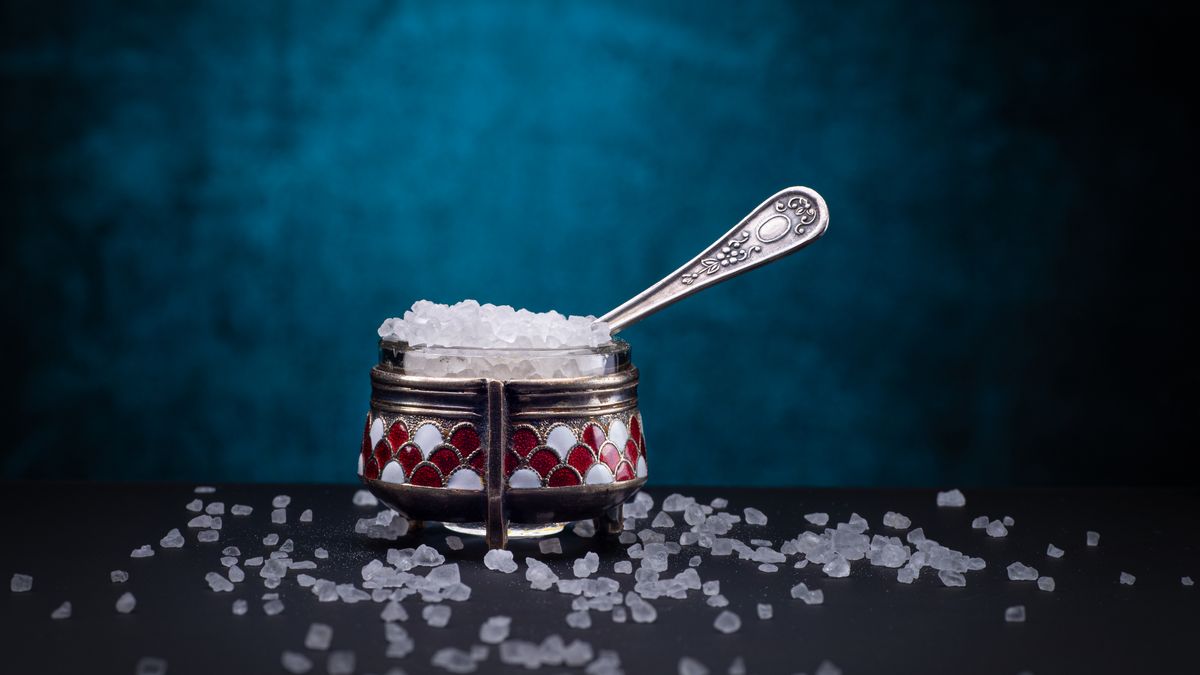
2% salt by weight of cabbage. Not by volume. Not by taste. By weight. Get a kitchen scale. This is non-negotiable.
For a 900g head of prepped cabbage: 900 × 0.02 = 18g of fine sea salt. That's about 1 tablespoon, but “about” isn't good enough. Volumetric measurements vary by crystal size by up to 40%. Weigh it.
Below 1.5%, you risk pathogen survival before Lactobacillus acidifies the environment. Above 3%, fermentation slows dramatically and the kraut tastes like a salt lick. 2% is the sweet spot backed by decades of food science (PMID: 38717160).
Use our Lab Calculator to convert between percentage, weight, and volume for any batch size.
Ingredients
- 1 medium head green cabbage (~2 lbs / 900g, cored)
- 18g fine sea salt (2% of cabbage weight)
- 1 head garlic, roasted (400°F for 35 min)
- 1 tsp freshly cracked black pepper
- 1 wide-mouth quart jar
- 1 fermentation weight + airlock lid
Equipment: pH meter, kitchen scale, Salt Calculator. Estimate cost with our Cost Calculator.
Instructions
 1
1Prep the cabbage and garlic
Remove outer leaves and core from one medium head of green cabbage (about 2 lbs). Slice thin — 1/8 inch or a mandoline's thinnest setting. Peel and roast a full head of garlic at 400°F for 35 minutes until soft and caramelized. Raw garlic works too, but roasted garlic is sweeter and less aggressive during early fermentation.
Chemist's note
Weigh your cabbage after removing the core and outer leaves. Your salt calculation depends on this number being accurate.
 2
2Salt and massage
Weigh your prepped cabbage. Multiply by 0.02 — that's your salt in grams. For a 900g head, that's 18g of salt. Sprinkle the salt over the cabbage in a large bowl and massage with both hands for 8–10 minutes. The cell walls break down and release water. You'll know it's ready when the cabbage is limp, translucent, and sitting in a pool of its own brine.
Chemist's note
Do not add water. Ever. Sauerkraut is a dry-salt ferment. The brine comes from the cabbage itself. If you're not getting enough liquid, you didn't massage long enough.
 3
3Add garlic, pepper, and pack the jar
Squeeze the roasted garlic cloves out of their skins and fold into the cabbage along with 1 tsp freshly cracked black pepper. Pack tightly into a wide-mouth quart jar, pressing down hard with your fist or a tamper after each handful. The brine must rise above the cabbage. Leave 1–2 inches of headspace.
Chemist's note
The compression is everything. Pound it. Slam it. Lactobacillus is anaerobic — any cabbage above the brine line is exposed to oxygen and will mold.
 4
4Weigh down and ferment
Place a fermentation weight or a small jar filled with water on top to keep the cabbage submerged. Cover with an airlock lid or loose regular lid (burp daily if no airlock). Ferment at 65–75°F for 2–4 weeks. You'll see bubbles within 48 hours — that's CO2 from the Lactobacillus converting sugars to lactic acid.
Chemist's note
Temperature matters more than time. At 65°F, ferment 3–4 weeks for complex flavor. At 75°F, it'll be done in 2 weeks but taste simpler. I prefer 68°F for 3 weeks.
 5
5Test and store
Start tasting at day 14. Target pH is 3.2–3.6. When it's tangy, slightly funky, and the cabbage has lost its raw crunch but still has some bite — it's done. Transfer to the fridge. Fermentation slows to nearly zero below 38°F. It'll keep for 6+ months.
Chemist's note
Use your pH meter, not your intuition. Below 3.6 means Lactobacillus has dominated and pathogens can't survive. That's the safety threshold (PMID: 38717160).
Sauerkraut with caraway seeds
This is the traditional German variation. Caraway seeds contain carvone and limonene — volatile compounds that intensify during fermentation as the acidic environment extracts them more efficiently than water alone.
Add 1 tablespoon of whole caraway seeds during the massage step (Step 2). Don't toast them first. The fermentation does the flavor extraction for you over 3 weeks, which is gentler and more complete than 30 seconds in a dry pan.
Some recipes add juniper berries alongside caraway. I've tested it. The juniper overpowers the garlic in this recipe. If you want caraway + juniper, drop the roasted garlic and make a traditional Bavarian kraut instead. Don't try to do both.
Jalapeño sauerkraut
Capsaicin is stable during lacto-fermentation. The heat doesn't decrease. If anything, the lactic acid amplifies the perception of spice because acid sensitizes TRPV1 receptors on your tongue. Translation: fermented jalapeños taste hotter than fresh ones.
Slice 2–3 jalapeños thin (seeds in for heat, seeds out for flavor without fire). Add them during Step 3 when you're packing the jar. They'll distribute evenly as you press down.
Keep the roasted garlic. Garlic + jalapeño + fermentation is one of the best flavor combinations I've found in 40+ batches. The sweetness of the roasted garlic balances the capsaicin burn.
Bump the salt to 2.2% for the jalapeño version. Peppers have higher water content than cabbage, so you need slightly more salt to maintain the same effective concentration in the brine.
Is sauerkraut low FODMAP?
Yes. Raw cabbage is high FODMAP due to mannitol and fructans. But fermentation changes the math. Lactobacillus bacteria consume these FODMAPs as their primary carbon source during the first 7–14 days of fermentation.
By the time sauerkraut reaches pH 3.5, the mannitol and fructan content has dropped by 70–90% compared to raw cabbage. Monash University — the institution that created the FODMAP framework — certifies sauerkraut as low FODMAP at a standard serving of 75g (about 2 tablespoons).
The caveat: fermentation time matters. A 5-day kraut still has significant FODMAPs. A 21-day kraut does not. If you're sensitive, ferment the full 3–4 weeks and verify pH is below 3.6 before eating.
One more thing. This recipe uses roasted garlic, which is also high FODMAP when raw. Roasting reduces fructan content by roughly 30%, and the subsequent 3-week fermentation reduces it further. But if you're extremely FODMAP-sensitive, make this recipe without garlic and add garlic-infused oil at serving instead.
A 2021 Cell study (PMID: 34256014) found that high-fermented-food diets increased microbiota diversity and reduced 19 inflammatory markers — particularly relevant for IBS patients who follow low-FODMAP protocols.
Troubleshooting
Not enough brine after massaging
You didn't massage long enough. Give it 10 full minutes. If still not enough after 15, add 1/4 tsp more salt and wait 30 minutes — osmotic pressure needs time. Never add water.
White film on the surface
That's kahm yeast. Harmless but tastes off. Skim it. Ensure cabbage stays submerged. Kahm grows when oxygen contacts the brine surface.
Pink or black mold
Discard the batch. Pink mold (Rhodotorula) or black mold means oxygen exposure was too high for too long. Check your weight and seal.
Too salty after 3 weeks
Your salt percentage was too high, or your cabbage was small. Next batch, weigh the cabbage precisely and use exactly 2%. Time won't fix over-salting.
Soft, mushy texture
Fermentation temperature was too high. Above 78°F, enzymatic breakdown accelerates. Aim for 65–72°F next time.
The science
Sauerkraut fermentation follows a predictable microbial succession. Leuconostoc mesenteroides dominates days 1–5, producing CO2 and lowering pH from ~6.0 to ~4.5. Then Lactobacillus plantarum takes over and drives pH below 3.6 over the next 2 weeks. This succession is why temperature control matters — too warm and L. plantarum dominates early, skipping the Leuconostoc phase that creates flavor complexity.
A 2024 safety analysis (PMID: 38717160) confirmed that lacto-fermented vegetables with pH below 4.4 are safe from pathogen survival. Properly fermented sauerkraut at pH 3.2–3.6 is well below this threshold.
A landmark 2021 Cell study (PMID: 34256014) showed that a high-fermented-food diet increased gut microbiota diversity by 15% and reduced 19 inflammatory proteins, including IL-6 and CRP. Sauerkraut was one of the primary fermented foods in the study.
Read all research on our Science page.